
Current Enterprise Data Strategies

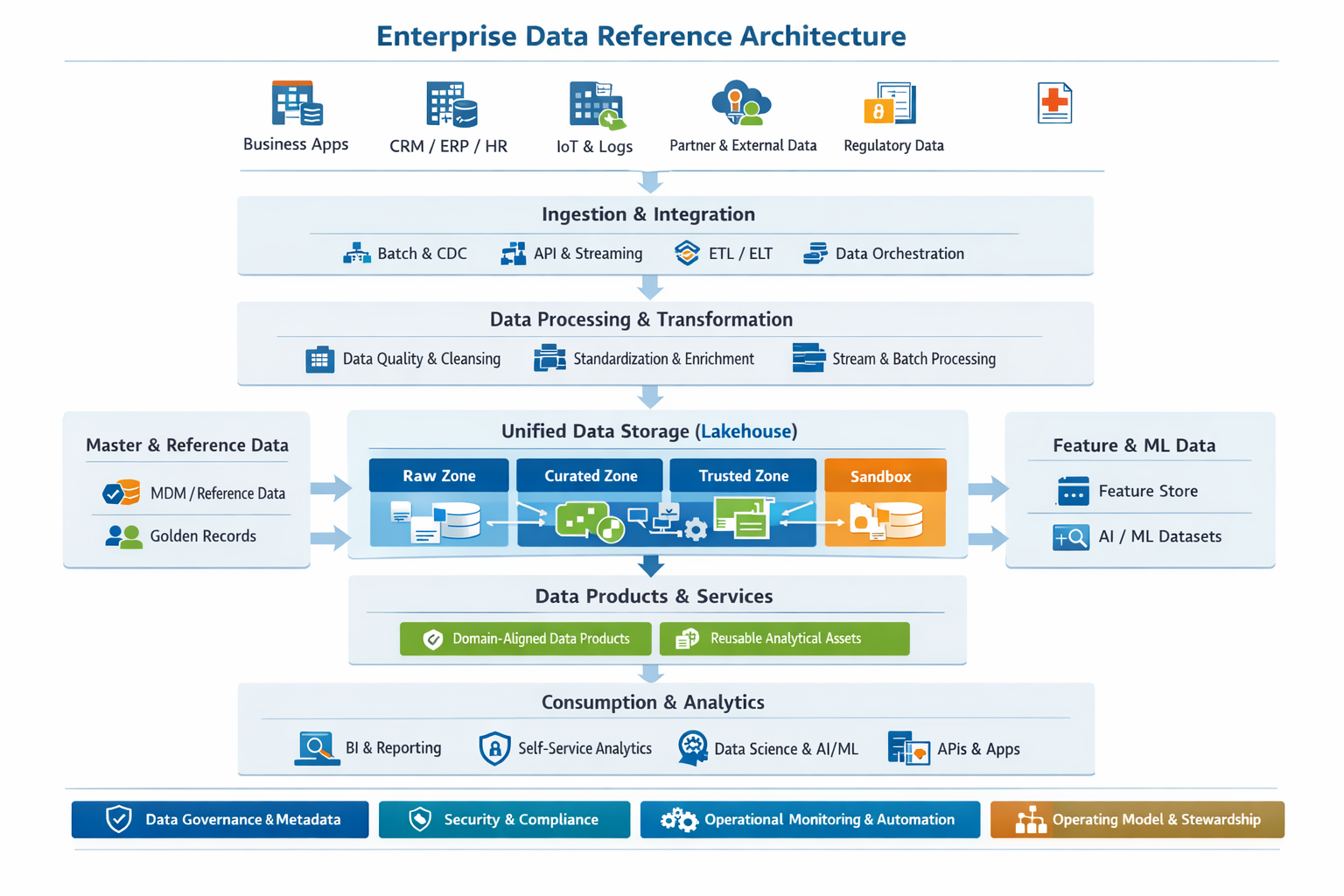
Earlier days it was all about Business Intelligence and Enterprise Data Warehouse but today many companies with demanding business needs are looking in various areas. Based on current industry direction, here are the most relevant Enterprise Data Strategy themes that one must know.
Data as a Product (Data Mesh Mindset)
What it is
- Treating data like a product with ownership, SLAs and lifecycle
- Domain teams own their data (not central IT bottlenecks)
What companies want
- Faster delivery of data
- Better accountability
- Reduced dependency on central teams
From my experience, I’ve seen a shift from centralised data platforms to domain-oriented ownership. I focus on enabling data products with clear ownership, governance, and discoverability while still maintaining enterprise standards.
☁️ Lakehouse + Modern Data Platforms
What it is
- Converging data lakes + data warehouses
- Supporting AI, BI, and real-time analytics on one platform
What companies want
- Simplified architecture
- Cost efficiency
- AI readiness
Modern enterprises are converging towards lakehouse architectures to unify structured and unstructured data. Off late, as an Architect, my focus is shifted around designing platforms that support both analytics and AI workloads while embedding governance and security by design
🤖 AI-Ready Data Foundations
What it is
- Preparing data for:
- AI/ML
- Generative AI
- Real-time decisioning
What companies want
- Trusted, high-quality data
- Feature stores
- Scalable pipelines
A key shift is designing data platforms not just for reporting but for AI consumption. That means focusing on data quality, lineage, and feature engineering capabilities from the start
🔐 Data Governance 2.0 (Active Governance)
What it is
- Moving from passive governance to:
- Automated
- Embedded in pipelines
- Policy-driven
What companies want
- Compliance (GDPR, security)
- Trust in data
- Reduced manual effort
Organisations are moving towards active governance where policies are enforced within data pipelines. The focus now is about embedding metadata, lineage, and quality controls directly into the architecture rather than treating governance as a separate function
⚡ Real-Time / Event-Driven Data Architecture
What it is
- Shift from batch → real-time streaming
- Event-driven systems using tools like Kafka
What companies want
- Instant insights
- Operational analytics
- Customer experience improvements
There’s a growing demand for real-time data capabilities. Focus these days for the architects is mainly on the event-driven architectures that integrate streaming with traditional batch processing to support both operational and analytical use cases
🌐 Data Democratisation (Self-Service Analytics)
What it is
- Enabling business users to access data easily
- Reducing IT bottlenecks
What companies want
- Faster insights
- Business empowerment
- Reduced shadow IT
A major theme is enabling self-service analytics while maintaining governance. The challenge is balancing accessibility with control, which I address through curated data products and strong metadata management.
🧱 Data Fabric / Data Virtualisation
What it is
- Connecting distributed data across:
- Cloud
- On-prem
- Multiple platforms
What companies want
- Unified access without heavy movement
- Faster integration
Many organisations are exploring data fabric approaches to unify access across distributed environments. I see this as complementary to lakehouse, especially in hybrid and regulated environments.
🏢 Cloud-First + Hybrid Data Strategy
What it is
- Cloud adoption with hybrid realities (especially in defence, finance)
What companies want
- Scalability
- Flexibility
- Compliance
While cloud-first is the direction, many enterprises operate in hybrid models due to regulatory constraints. As an architect, our focus should be designing architectures that seamlessly operate across cloud and on-prem environments
📊 Data Operating Model Transformation
What it is
- Redefining:
- Roles (CDO, data owners, stewards)
- Processes
- Governance structures
What companies want
- Clear accountability
- Scalable delivery
Technology alone doesn’t solve data challenges — operating models are critical. Architect should focus on defining roles, responsibilities, and governance structures that enable sustainable data adoption
🔗 Metadata-Driven Architecture
What it is
- Using metadata as the backbone:
- Lineage
- Catalogs
- Automation
What companies want
- Data discovery
- Trust
- Automation
Metadata is becoming central to modern data platforms. One must focus on building metadata-driven architectures that enable lineage, governance, and self-service capabilities.